Nothing in cart




Good price and arrived in no time, thanks.
20th order by Robert from QLD
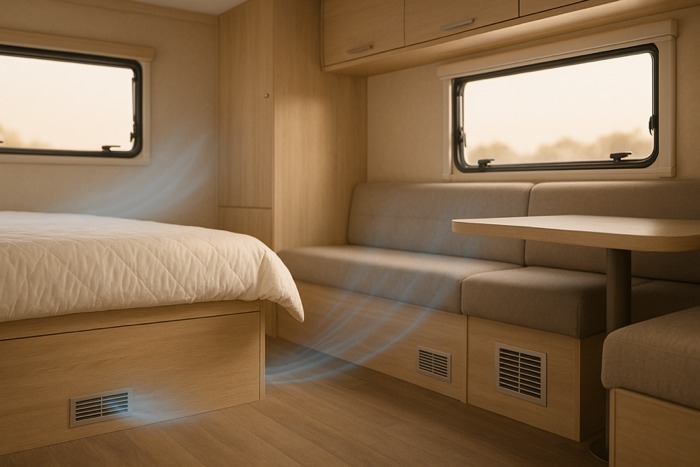
For years, cooling a caravan or RV meant cutting a big hole in the roof, hoisting a bulky 40kg unit into place and living with the height and wind noise. Today there is a quieter, neater answer under the mattress.
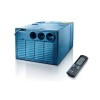
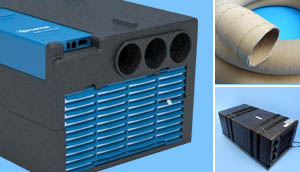
Under-bunk air conditioners tuck into cabinetry and send air through discreet 60mm ducts throughout the cabin. They are reverse-cycle heat pumps, so they can cool in summer and provide heating support in cooler weather, without putting another large unit on the roof.
I am the first to admit rooftop units still dominate new builds, but an under-bunk layout answers several pain points such as clearance and weight distribution. Pop-tops and camper trailers often cannot carry the extra mass, while many full-height vans cannot spare another 300mm on the roof.
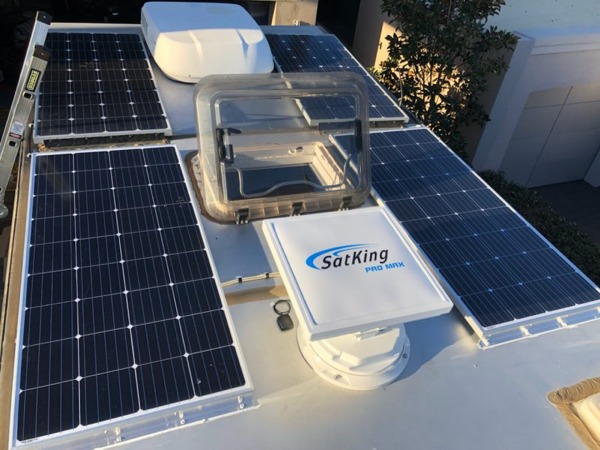
Moving about 30kg of hardware down low lowers the centre of gravity and removes a wind-catching lump from the roofline. It also frees prime roof real estate for solar, hatches, Starlink or a rack, so owners can chase bigger arrays or even add a second skylight. In terms of acoustic comfort, you can aim the ducted outlets away from the bedhead while the compressor sits behind insulation, making night-time operation noticeably gentler.
Fitting a modern under-bunk unit is quite practical for many builds, but it still rewards good planning. The main checks are:
For any 230V wiring, inverter integration or fixed electrical connection, use a qualified electrician. The physical fit can be straightforward, but the electrical side needs to be designed and tested properly.
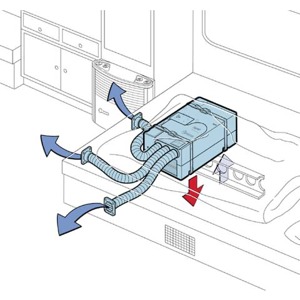
Truma Saphir set the early benchmark: quiet, beautifully engineered and undeniably premium. Its 7,000BTU (2.0kW) cooling output made it the logical choice for builds that could not wear a rooftop unit, but the price kept it in "nice-to-have" territory for many.
A decade on, Chinese factories brought the HB9000 platform to market. Badged locally as Houghton Belaire, Finch, Cool-J and Furrion, the HB9000 offered 9,000BTU (2.6kW) of cooling at a friendlier price. That bump in capacity, plus affordability, shifted under-bunks from "aspirational" to "achievable upgrade".
We trialled multiple variants and backed Cool-J for one reason above all: after-sales support that matched our own standards. Their HB9000 Plus added Wi-Fi control, a quieter EPP chassis and an auxiliary electric heater for frosty mornings. It quickly became our best-selling air conditioner across the lot, not just among under-bunks.
Traditional caravan units use a fixed-speed compressor: full blast on, full stop off. An inverter compressor varies its speed to match the load. The benefits are immediate: lower start-up current, steadier temperatures and a smoother noise profile. It is the same principle as a premium home split-system, scaled for RV life.
In mid-2025, Cool-J iHider arrived as the first under-bunk with an inverter compressor. It is rated at 10,000BTU (2.95kW) and, crucially, can sit under about 1kW once it is pulling the cabin down to setpoint. Add smartphone control and soft-start behaviour and you have a realistic path for lithium-equipped travellers to stretch comfort off-grid.
Energy Efficiency Ratio (EER) is the quick way to compare "cooling out" versus "power in".
EER = Cooling output (kW) / Electrical input (kW)
From current models you will commonly see:
What that means in practice: take Truma Saphir at 2.4 as a baseline. A Freucamp at 2.2 will do the job but typically needs about 10% more power to hold the same temperature. Step up to HB9000 Plus at 2.8 and you are around 15% less power than the baseline. The iHider at 3.0 trims that to roughly 20% less. EER is a lab metric, and installation quality and ambient conditions still matter, but it is a solid like-for-like compass. For heating, look to COP rather than EER.
On capacity, the HB9000 platform already leapfrogged the Saphir; the iHider stretches that lead while cutting average consumption thanks to the inverter. Prices have tightened: Saphir remains at the premium end, HB9000 variants typically sit around the mid-range, and iHider launched below the top bracket despite its new tech. Features that once sounded fancy, such as Wi-Fi control, self-diagnostics and low-temperature boost heat, are now normal for quality under-bunks.
An under-bunk system is a strong fit when roof space is already busy, when the van cannot take a rooftop unit, or when you want the weight and noise lower in the van. Before ordering, check the available cabinet space, under-floor vent position, duct routes, drain path and where the return air will come from.
If you are planning off-grid use, treat the air conditioner as part of the full electrical system. Battery size, inverter rating, solar input, generator support and cable runs all affect the real result. The unit can be efficient, but the system around it still needs to be sized properly.
Rooftop units will keep their strong share on factory builds, but the equation has changed. If you are guarding roof space for solar, chasing a calmer sleep, or simply prefer the weight down low, an under-bunk air conditioner is no longer a compromise; it is often the better solution. With inverter technology now under the bunk, serious off-grid comfort is in reach. If your next build needs even, quiet air without surrendering a square centimetre upstairs, put an under-bunk system on the shortlist's top line.