
Nothing in cart



So accommodating with my request, quick response and follow up on the tracking of the product, will definitely be my go to for my next caravan update 😊
1st order by Fiona from VIC

When you're on the road, television might not be your top priority - until you settle into camp, the weather turns, or there is something on you actually want to watch.
That is where a good 12V omnidirectional antenna becomes more than just another fitting on the roof.
For years, the traditional wind-up directional antenna was the standard choice. These still have their place, especially in fringe reception areas, but they usually need to be raised, rotated, aimed at the nearest tower, and lowered again before travel.
Omnidirectional antennas take a different approach. They are designed to receive signal from all directions, which means there is no need to aim the antenna each time you pull up. For many modern caravanners, that convenience is the main reason they have become so popular.
But convenience is only part of the story. Gain, noise figure, antenna size, installation quality and where you travel all play a part in the final result. The best antenna is not always the biggest one, or the one with the highest gain number. It is the one that best suits the way you use your caravan.
Omnidirectional antennas are best suited to travellers who value simplicity.
If you regularly move from place to place, stay in caravan parks, tour coastal areas, or camp within reasonable range of towns and regional centres, an omnidirectional antenna can make a lot of sense.
You pull up, turn on the TV, scan for channels if needed, and avoid the usual process of raising and aiming a directional antenna.
They are also a neat option for modern caravan roofs, where space is often shared with solar panels, roof hatches, air conditioners, satellite dishes and vents. Most dome-style antennas are compact, fixed in place, and low enough that you do not need to think about them every time you leave camp.
Where they are less ideal is true fringe-area reception.
If you regularly camp in remote valleys, heavily treed sites, hilly terrain, or right at the edge of broadcast coverage, a directional antenna may still give you the best chance of pulling in a weak signal. Directional antennas can be aimed at a tower, which helps concentrate reception in one direction.
An omnidirectional antenna collects signal from all around, which is simpler, but not always as powerful in difficult locations.
So the choice is not really about which style is better. It is about how you travel.
For more detail on directional antennas and general reception tips, see our earlier guide on improving caravan TV reception.
When comparing caravan TV antennas, two of the most useful specifications are gain and noise figure.
These numbers help explain why one antenna can give a cleaner, more stable picture than another, even when the higher-priced or higher-gain model is not always the obvious winner.
Your TV does not just need a strong signal. It needs a clean signal.
Gain is measured in decibels, or dB. In simple terms, it tells you how much the antenna and amplifier boost the incoming TV signal.
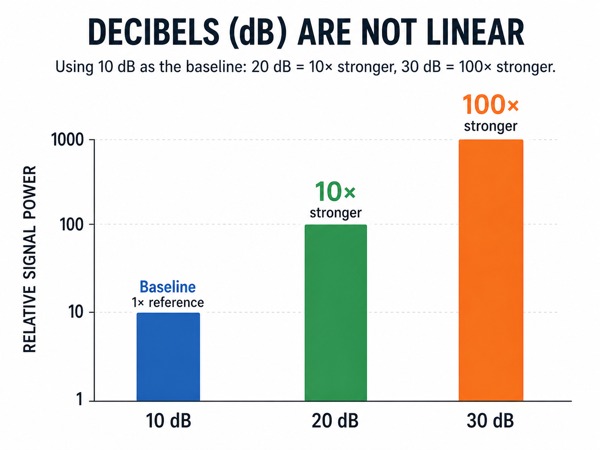
The important thing to remember is that decibels are not measured on a straight scale. Every increase of around 3 dB roughly doubles the signal power, while every increase of around 10 dB is about ten times the signal power.
That means a 30 dB antenna is not simply a bit stronger than a 20 dB antenna. On paper, it represents a much bigger increase in signal power.
But more gain is not automatically better.
In weak signal areas, extra gain can help lift the signal to a usable level. In strong signal areas, too much gain can overload the TV tuner or amplifier, causing pixelation, dropouts or unstable reception.
This is why some high-gain systems include a gain control or attenuator, allowing the signal to be turned down when travelling through strong reception areas.
This is where it becomes important to look beyond the headline gain figure.
Noise figure is one of the most important antenna specifications, but it is often overlooked.
Every amplifier adds a small amount of electronic noise to the signal. This is measured as Noise Figure, usually shown as dB NF. The lower the number, the cleaner the amplified signal should be.
A low-noise amplifier is a bit like listening in a quiet room. A high-noise amplifier is like turning up the volume in a room full of static. The signal may be louder, but it is not necessarily clearer.
This is why a balanced antenna can outperform one with a bigger headline gain figure. For example, a 25 dB antenna with a very low noise figure may deliver a cleaner result than a 35 dB antenna with a noisier amplifier.
Your TV cares about signal quality, not just signal strength.
Antenna size still matters.
Small domes are neat, aerodynamic and easy to fit into crowded roof layouts. They can be a great choice for metro areas, coastal touring and caravan park use where reception is generally strong.
Medium domes are often the best all-round option. They provide a larger receiving area without taking up excessive roof space, making them a good match for many touring caravans.
Larger domes are usually aimed at travellers wanting stronger reception performance. They can offer higher gain and better fringe-area capability, but they also take up more roof space and may be more than needed for strong-signal areas.
The trick is not to buy the largest antenna automatically. The trick is to match the antenna to how and where you travel.
A good antenna can only do so much if the rest of the installation is poor.
Coax cable, joins, wall plates, splitters, amplifier power supply and TV tuning all affect the final result. A weak connection or damaged cable can make a quality antenna look ordinary.
When replacing an older caravan antenna, it is worth checking the whole signal path rather than assuming the dome alone will fix every reception issue.
Old coax can deteriorate. Poorly fitted connectors can introduce signal loss. Splitters can reduce signal strength. Wall plates and boosters can fail or become outdated.
For best results, the system should remain consistent from antenna to TV. Caravan TV systems generally use 75 ohm coax and fittings, so the antenna, cable, splitter, wall plate and TV tuner should all be suited to that standard.
A clean installation matters.
Some modern caravan antennas include 4G or LTE filtering.
This helps reduce interference from mobile phone signals, which can be useful around towns, caravan parks and built-up areas where wireless signals are everywhere.
A 4G/LTE filter will not create TV signal where there is none. It will not turn a remote black spot into a strong reception area. What it can do is help keep unwanted mobile interference away from the TV signal, giving the tuner a cleaner signal to work with.
In marginal areas, that can make a difference.
For simple everyday touring, a medium low-noise omnidirectional antenna is often the most practical choice. This style suits travellers moving between towns, caravan parks, coastal areas and regular touring routes.
For limited roof space, a compact dome may be the better fit. This is especially useful where the roof is already crowded with solar panels, hatches, vents or an air conditioner.
For stronger regional or fringe-area performance, look toward larger or higher-gain models. These are designed to give the TV tuner more signal to work with when reception is weaker.
For remote touring, heavily treed camps or difficult terrain, it may still be worth considering whether a directional antenna is the better fit. Omnidirectional antennas are convenient, but convenience does not always beat direct aiming when the signal is already marginal.
As a general buying checklist, consider the antenna's gain, noise figure, size, power requirements, VHF/UHF coverage, roof space and installation quality.
The best choice is not necessarily the most powerful antenna on the page. It is the antenna that best matches your travel style and the reception conditions you are most likely to face.
Once you understand the basics, the right choice usually comes down to how you travel, how much roof space you have available, and how often you camp in weaker reception areas.
Here are a few popular options to compare.
For a wider comparison of omnidirectional antennas, including gain, noise figure, warranty and dimensions, see our comparison guide below.
Before ordering, check the roof space, the antenna height, the power supply style and the coax path through the van. Also check whether you need VHF, UHF or both for the areas you travel through.
If the roof is already crowded, a compact dome may be the cleanest fit. If you travel further from towns, a larger low-noise model may be worth the extra roof space.
Omnidirectional antennas suit the way many people now travel. They are simple, fixed in place, easy to use, and well suited to regular touring where convenience matters.
A medium-sized, low-noise dome is a very practical everyday choice for many caravanners, especially those travelling through towns, coastal areas and caravan parks.
If you spend more time near the edge of broadcast coverage, a larger high-gain model may give you a better chance of holding signal. If you mostly camp in strong reception areas, a compact or mid-range dome may be all you need.
Choose the right model, install it properly, keep the cabling and connections clean, and you will spend less time chasing reception - and more time enjoying the picture.


So accommodating with my request, quick response and follow up on the tracking of the product, will definitely be my go to for my next caravan update 😊
Parts took a while due to supplier issues - however, Caravan Plus kept me updated during the whole process and I successfully received my parts in good order. Although my order was small and inexpensive, I felt like they handled it with as much importance as a large scale order. Nice to see this level of service still exists. Well done Caravan Plus.
Very quick delivery and exactly what was needed!