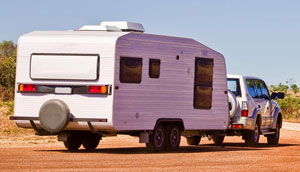
You need towing mirrors if your normal vehicle mirrors do not give a clear rearward view past the caravan, camper, horse float or trailer. In practice, most caravans are wider than the tow vehicle, so most caravan setups need extension mirrors.
The legal point is rearward vision, not simply owning a set of extra mirrors. You need to be able to see down the sides of the towed load and enough road behind it to change lanes and monitor traffic safely. If the caravan blocks that view, fit towing mirrors before you drive.
Towing mirrors help recover the side and rear vision lost when the van is wider than the vehicle.
If you can clearly see down both sides with your existing mirrors, extra mirrors may not be needed. If you can only see well on the driver's side, fit both sides. The passenger side is still important for lane changes, reversing, overtaking traffic and checking the caravan's position.
2. Check Your Setup First
Before choosing mirrors, check three things: the width of the caravan, the shape of your vehicle's side mirrors, and how often you tow. A small camper behind a wide 4WD may only need simple clip-on mirrors. A full-width caravan behind a narrower wagon or ute often needs a wider, more stable mirror.
Check that the mirror head reaches wide enough to see past the van.
Make sure the clamp or strap suits your mirror housing and does not foul indicators, cameras or folding mechanisms.
Look for a mirror that remains stable when trucks pass or when travelling at highway speed.
Remove portable mirrors when you are not towing so they do not stick out unnecessarily.
Cars with very tapered mirror housings, auto-folding mirrors or unusual mirror bezels may need different pads or a different mirror style. If the mirror moves, vibrates heavily or has come off before, do not keep using it without changing the fitting method.
3. Mirror Mounted Towing Mirrors
Mirror-mounted towing mirrors are quick to fit and suit many occasional towing setups.
Mirror-mounted towing mirrors clamp or strap onto the vehicle's existing side mirrors. They are usually the easiest to set up and remove, which makes them a good choice for occasional trips or shared vehicles.
The Milenco Grand Aero4 mirrors are popular because they are stable, easy to adjust and fit many vehicles. The large head gives good rear vision and can be rotated to suit different setups. If your vehicle mirror has a very tapered housing, the correct Milenco pads can make a big difference to grip.
The Milenco Grand Aero Platinum mirrors use an upgraded gripper plate design for difficult mirror housings and extra stability. They are worth considering if a normal clamp-on mirror is not gripping well enough.
Door-mounted mirrors can be steadier than cheap clip-on mirrors, but take longer to fit.
Door-mounted mirrors can suit vehicles where the factory mirror housing is too small, too tapered, or too awkward for a clip-on mirror. They are usually more stable than basic strap-on mirrors, but they are bulkier and take more time to fit.
Bonnet-mounted mirrors use a bar or support across the front of the vehicle. They are less common now because good mirror-mounted and full replacement options are easier to live with. They can also be harder to adjust from the driver's seat.
Bonnet-mounted mirrors are an older style and are usually less convenient.
5. Full Replacement Towing Mirrors
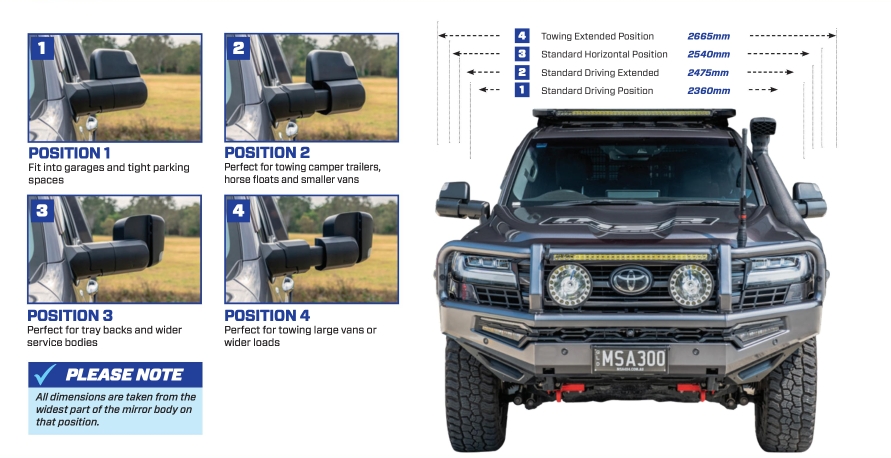
If you tow often, a full replacement mirror can be the neatest long-term option. These replace the vehicle's original mirrors and slide or extend out when towing, then tuck back in for everyday driving.
MSA towing mirrors are vehicle-specific, so choosing the correct model, year range, indicator type, blind-spot monitoring and power-fold option matters. They cost more than portable mirrors, but they are more convenient for frequent towing and are less likely to vibrate or move when fitted correctly.
Full replacement mirrors suit frequent towing and vehicle-specific fitment.
A rear view camera on the caravan is useful extra vision, especially for reversing, watching traffic behind the van and checking what is close behind you. It is not a substitute for towing mirrors because it does not give the same side view for lane changes and overtaking.
The best towing mirror depends on how often you tow and how stable the mirror needs to be.
Mirror type
Best suited to
Main trade-off
Basic clip-on
Occasional towing, short trips, small campers
Can vibrate or move if the fit is poor
Quality mirror-mounted
Most caravan owners wanting portable mirrors
Needs the right clamp/pad setup for the vehicle mirror
Door or bonnet mounted
Difficult vehicle mirrors or older setups
Bulkier and slower to fit
Full replacement
Frequent towing and touring
Higher cost and vehicle-specific fitment
For most occasional or medium-use towing, start with a quality mirror-mounted pair and check the fit carefully. If you tow often, travel long distances, or have had portable mirrors move or come loose, vehicle-specific replacement mirrors are worth considering.