
Nothing in cart






The Grommets look great but with in a couple of days a couple of them have already broken from having to remove the burner stands to clean around the burners.
2nd order by David from NSW
AGM batteries were the standard deep-cycle choice in caravans and RVs for many years, and they are still a practical option for simple camping setups. Lithium batteries cost more upfront, but they can give more usable capacity, lower weight, faster charging and stronger inverter performance when the rest of the electrical system is set up for them.
The best choice depends on how you travel. If you mostly stay on powered sites and only need lights, water pump and a small 12V load, AGM may still be enough. If you free camp, use solar, run a DC-DC charger, or want to power larger inverter loads, lithium is usually worth considering.
Before changing to lithium, check the battery charger, solar regulator, DC-DC charger, BMS requirements and any appliance warranty conditions. Do not assume an old AGM charging system is automatically suitable for a lithium battery.
For most new touring setups, lithium is the better long-term battery technology. It is lighter, charges faster, can deliver more usable capacity, and handles inverter loads better than AGM.
AGM still has a place where the setup is simple, the budget is tight, cold-weather charging is a concern, or the existing charging system is not lithium compatible. The mistake is choosing by battery price alone. Compare usable amp hours, charging equipment, expected cycle life and how much power you actually use away from mains power.
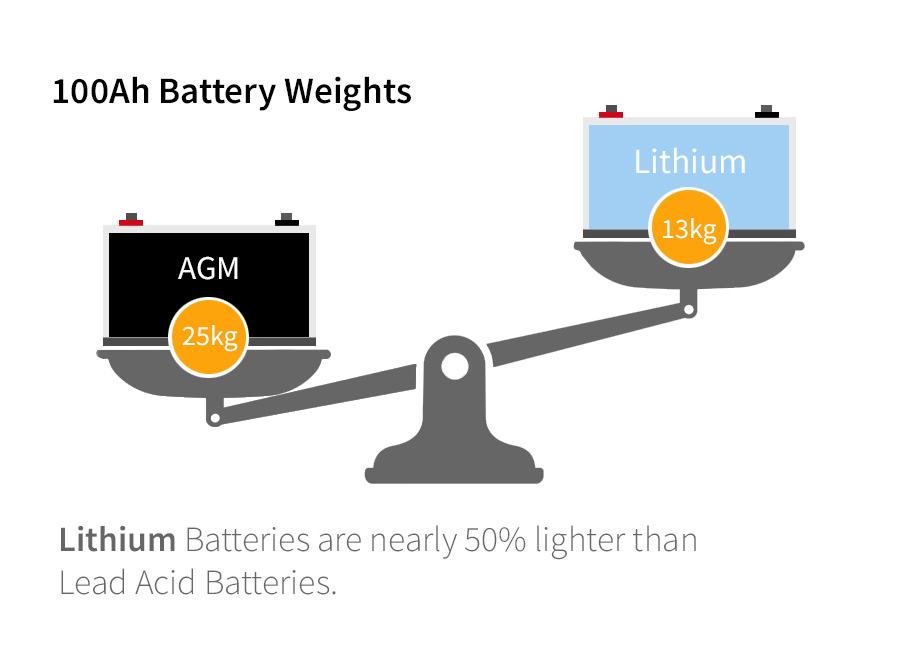
Lithium batteries are much lighter than equivalent lead-acid batteries. That matters in caravans because every kilogram affects payload. In many setups, lithium lets you carry similar or greater usable battery capacity at a lower weight.
A 100Ah AGM battery is not normally treated as 100Ah of everyday usable power. To preserve life, AGM batteries are commonly kept above about 50% state of charge, which gives roughly 50Ah of practical use from a 100Ah battery.
Lithium batteries can generally be discharged deeper, often to around 20% state of charge depending on the battery and BMS. That means a 100Ah lithium battery can often provide more usable energy than a 100Ah AGM.

AGM voltage also falls more steadily as the battery discharges. Lithium voltage stays flatter for longer, then drops quickly near the end of its usable range. This can make lithium feel stronger under load, but it also makes a proper battery monitor more useful because voltage alone is not always a clear guide.
Caravans now often carry larger electrical loads: coffee machines, induction cooking, hair dryers, microwaves and other 240V appliances used through an inverter. These loads draw high current from the battery bank.
AGM batteries can provide high current for short periods, but they are not ideal for sustained heavy inverter loads. Lithium batteries usually handle higher continuous discharge better, provided the battery BMS, cables, fuses and inverter are sized correctly.
Charging is one of the biggest differences between AGM and lithium. AGM batteries need the correct bulk, absorption and float charging profile. They can also take a long time to reach a true full charge.
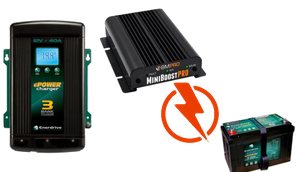
Lithium batteries can accept higher charge currents and often recharge faster, especially from a DC-DC charger or solar system. However, the charger must have a lithium-compatible profile and the installation must suit the battery's BMS and current limits.
If you are upgrading from AGM to lithium, check these items before buying the battery:
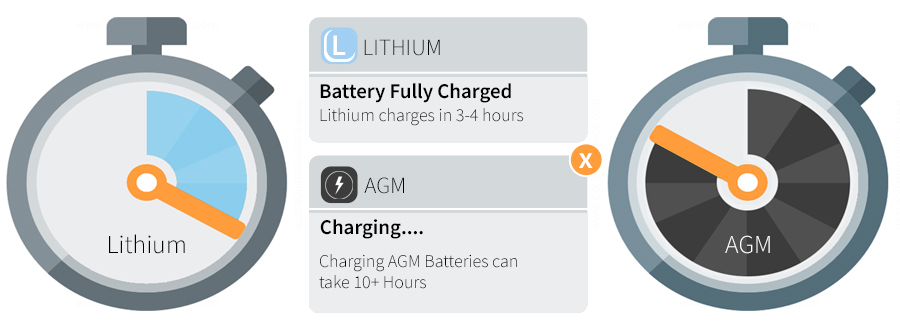
Battery lifespan is usually discussed in cycles: how many times the battery can be discharged and recharged before it has significantly reduced capacity. Depth of discharge has a major effect on cycle life.
AGM battery life is commonly based around shallower discharge. Lithium batteries are generally rated for more cycles and deeper everyday discharge, but only when they are charged, discharged and stored within the manufacturer's limits.

A lithium battery can last much longer than an AGM in a regular off-grid setup, but it still needs the right charger profile, sensible cable sizing, correct fusing and protection from unsuitable charging conditions.
Lithium costs more upfront. The fairer comparison is cost per usable amp hour over the battery's life, including how often the battery is cycled and how deeply it is discharged.

As a simple guide, a frequently used off-grid system usually favours lithium over time. A lightly used van that spends most nights on mains power may take much longer to recover the extra upfront cost.
Choose AGM when the setup is simple, low-cost and lightly used away from mains power. Choose lithium when weight, usable capacity, faster charging and inverter performance matter enough to justify the battery and charger upgrade.
The advantages of lithium only become advantages if your electrical system can use them. Before changing battery type, check the chargers, solar regulator, inverter, cable sizing and battery monitor. If those parts are not compatible, the battery swap can become a system upgrade rather than a simple battery replacement.
Disclaimer - The information contained in these articles is provided in good faith and we do our best to ensure that it is accurate and up to date, however, we cannot be held responsible for any damage or loss arising from the use or mis-use of this information or from any errors or omissions.





The Grommets look great but with in a couple of days a couple of them have already broken from having to remove the burner stands to clean around the burners.
Fast delivery and fits perfectly
Very happy with sevice and promptness and the fact as we were travelling in the region we could pick our order up at the premises. Thank you