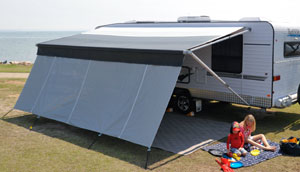
Awning roof rafters help reduce noisy wind flap and water pooling by adding support and tension to the awning canopy. They are especially useful on larger rollout awnings, older awnings with some sag, and sites where light rain can pool in the fabric.
Roof rafters installed on an awning
1. What awning rafters do
A roof rafter sits between the van wall and the awning roller or cassette, lifting the canopy slightly so it is less likely to flap or sag. It is not a storm brace, and it should not be used as a reason to leave an awning out in unsafe wind.
The right rafter depends on the awning type, canopy age, awning width, and how much curve or tension the fabric can comfortably take.
2. Curved rafters and curve size
Curved rafters are available with different curve amounts. As a general rule, use enough curve to support the canopy, but not so much that it over-stretches the fabric.
Older awnings that have already stretched and sagged may benefit from a larger curve. Newer awnings usually need less tension.
Side-by-side rafter curve comparison
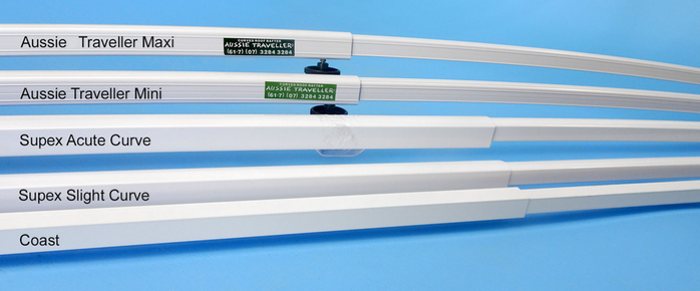
The curve measurements below are approximate and are measured from the ground to the underside of the rafter at the most curved point when extended to 2440mm. Manufacturing variation and extension length can change the exact figure.
The smallest curve we offer is the Coast Curved Rafter, with a curve of about 15-25mm. It is powder-coated white and has a square profile.
The Supex Slight Curve Rafter has an approximate curve of 25-35mm. Its rounded profile helps reduce wear against the awning and suits newer awnings or setups where only light support is needed.
The Supex Acute Curved Rafter has a larger 65-75mm curve for more canopy tension. It has a rounded profile, is powder-coated, and is available in white or black.
Aussie Traveller rafters have a solid construction and are available in Mini and Maxi sizes. The Mini has a larger curve than most standard curved rafters at about 90mm, while the Maxi is about 120mm and is generally best reserved for older or looser awnings.
The number of rafters depends on awning length and how much support is needed. Smaller awnings may only need one rafter, while larger awnings often benefit from two or more spaced evenly across the canopy.
Recommended rafters by awning length
4. How to install roof rafters
Most rollout awning roof rafters are simple to install and can then be fitted or removed quickly during awning setup.
The location depends on how many rafters you are using. For a single rafter, install it near the middle of the awning. For multiple rafters, space them evenly across the awning width.
Attach the wall bracket to the van wall with suitable screws and sealant. Extend the awning fully, make sure the roller keyway is facing down, and drill the roller tube hole at the correct height. De-burr the hole carefully so it cannot damage the awning fabric when closing.
5. Fiamma awning rafters
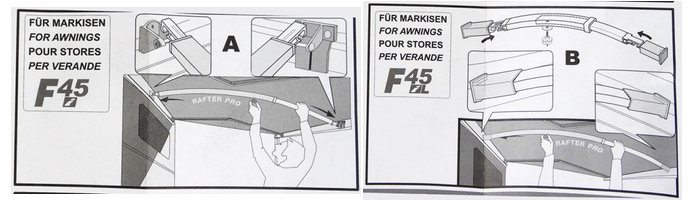
Fiamma has its own range of rafters for Fiamma awnings. For box awnings such as the F45 and F65, straight and curved styles are available.
These rafters require no drilling on most compatible Fiamma awnings and hook into clips already fitted to the awning. For older awnings without the clips, the rafter can still be used with the supplied end caps.
Fiamma CaravanStore bag awnings require a different rafter. The rafter below is only suitable for CaravanStore bag awnings and is not suitable for Fiamma F45 awnings.