
Nothing in cart





Excellent service one item out of stock kept us well informed give a delivery date very professional cheers john
2nd order by John from NSW
For a small trailer or light caravan, a standard jockey wheel is usually enough. For a heavier caravan, off-road drawbar or frequent setup, choose a stronger swivel model with a larger wheel. If you need to move a van by hand, look at ratchet or geared mover options. If you want a jockey wheel that can also help with wheel changes, a Trail-A-Mate is the practical upgrade.
The main things to check are shaft size, clamp/bracket style, height range, wheel size, drawbar clearance, ball weight rating and whether you need to manoeuvre the van while unhitched.

Start with how you use the van. If you only unhitch, level and leave the caravan in place, a strong conventional jockey wheel may be all you need. If you are older, managing a heavier van, or working on uneven ground, a smoother-winding heavy-duty model can make setup easier.
If you regularly push, turn or position the van without the tow vehicle, wheel size and traction matter more. Small solid wheels can dig into gravel or soft ground. Larger single wheels, twin wheels or geared movers spread the load and give better control.
| Use case | Good starting point |
|---|---|
| Small trailer or light camper | Standard jockey wheel with matching clamp |
| Caravan mostly unhitched and left in place | Heavy-duty standard or swivel jockey wheel |
| Off-road drawbar or rough site access | Large-wheel swivel jockey wheel with suitable height range |
| Manual positioning in a tight spot | Ratchet or geared mover, used within its rating |
| 12V caravan mover fitted | Twin-wheel jockey wheel to help the van pivot smoothly |
| Wheel changes or maintenance support | Trail-A-Mate hydraulic jockey wheel and jack kit |
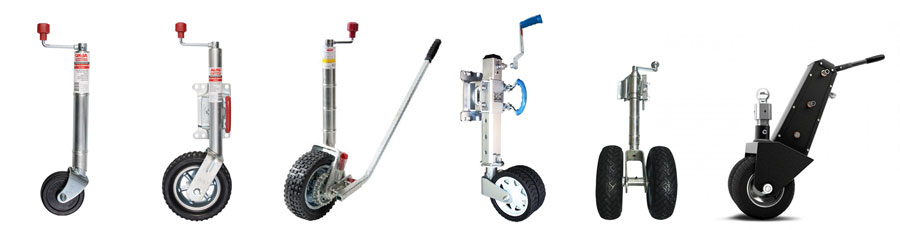
A standard jockey wheel is the familiar removable style used on many trailers and smaller caravans. It works well for simple unhitching and height adjustment when the van does not need much movement.
Swivel bracket jockey wheels stay attached to the A-frame. Pull the release handle, rotate the wheel down for use, then rotate it back up for travel. They save storage space and are convenient when the jockey wheel is used often.
Large-wheel swivel models are useful on rougher ground. The Ark XO style uses larger dual wheels and an adjustable starting height, which helps when the drawbar sits higher than a normal road trailer.

A ratchet jockey wheel is designed for moving a trailer or caravan by hand. It is useful where the tow vehicle cannot easily push the van into position, but it still needs firm ground, realistic ball weight and careful use on slopes.
The Trailer Valet style builds on the mover idea with geared drive and extra control. These are best treated as positioning tools, not as a substitute for safe towing or braking. Always stay within the product rating and avoid using them on unsafe slopes or loose ground.
The Trail-A-Mate is both a jockey wheel and a hydraulic jack. For caravanners who do not need to move the van by hand but want easier lifting for maintenance or wheel changes, it can make more sense than a mover-style jockey wheel.
It uses a 50mm shaft and suits standard clamps already fitted to many A-frames. The kit includes brackets for approved lifting points, and the detachable wheel can be swapped for the base plate when using it as a jack. Always follow the lifting instructions and use the supplied brackets in the correct position.
When the caravan is parked and unhitched, keep the jockey wheel as close as practical to directly under the A-frame load. The further the load sits away from the A-frame line, the more leverage is placed on the bracket.
If you use a pivoting jockey wheel, swing it up toward the A-frame for travel and make sure the wheel cannot scrape on the ground. Secure the winding handle so it cannot drop down, hit the road or contact the tow vehicle.
For caravans with a 12V mover fitted, a twin jockey wheel can help the van pivot more smoothly and reduce scrubbing compared with a narrow single wheel.




Excellent service one item out of stock kept us well informed give a delivery date very professional cheers john
This place has fair pricing and ships quickly. I ordered the awning wall which was the cheapest place around for the same branded product elsewhere. It arrived very quickly and that was awesome. Tried it on the van and it fits perfectly.
Fast and efficient